
SXSW Panel Disfigurement Discrimination
More than a third of people living with disfigurement have experienced employment discrimination. This is why our community matters and why we are heading to SXSW to make a case for it.
Since the inception of MIGA Swimwear, I have interviewed over 100 different people to understand the disability, chronic illness and disfigurement experience. The majority of the interviews have been conducted with women who have these conditions, to understand their unique views on life, on how best to live day-by-day with the uncertainty of a diagnosis, diagnosed or undiagnosed. All of these women are courageous, strong but above all resilient. And just like everyone else, they want the same as you and me. They want love, they want a job that makes them proud when they go to bed at night, they want to be respected, equally in their field and as valuable members of society. Ultimately, they want to belong.
While I have never been discriminated due to my disfigurement at a job interview (admittedly, I have never applied to be a foot model but I am pretty sure I would not get a callback), from a very young age, whether by explicit or implicit bias, I learned that my disfigurement was something I needed to hide. My disfigurement is something that brought my value, as a woman but also as a human being, into question. What was my value if something in my body didn’t look like everyone else’s? By 8th grade, I was convinced that my disfigurement was some kind of symbol that made me not cute enough, didn’t matter how much I would develop my personality. My worth would always come into play when I was barefoot. For some, my height or my short legs was enough of a tell-tale sign to label me as below average.
I used to look at myself in the mirror and think everything else looks passing as far as I keep my socks on. I did not realize, however, that giving up the freedom of being barefoot would replace one issue with another. At the beach or the pool, I would become quite socially anxious. While before I loved swimming, swimming competitively even, now I was passing the opportunity to go with my classmates on a cruise graduation trip. The thought of being barefoot 24/7 being too daunting to bare. By giving up that freedom, not only did social anxiety creep in, I started to feel the ick of dishonesty all over me. Add to that the internalized shame I felt for having a rare condition that made me “weird”. So now at the ripe age of 15 years old, I felt deceitful and fake.
There was no incentive to disclose, in fact I was encouraged by my parents not to, their protective side while well-intentioned doing more harm than good. In the years to come, I hope to become a mother and I wonder if in my parent’s position I would do anything differently. I grew up in the 90s, the psychology of appearance was not as advanced as it is today. With the advent of social media and the commodification of displaying what makes us unique, you can find communities in the far reaches of the web that celebrate your condition, no matter how rare. If I were to have been a parent in the 90s, I would probably done the same as my parents; the world was not ready for it then and yet, sometimes I wonder if it is ready for it now?
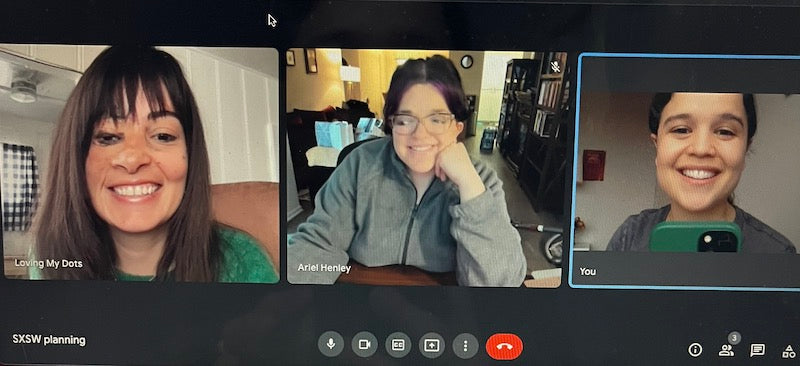
With the statistics of social media’s mental toll on appearance matters, I worry that it is not. More than a third of people living with disfigurement have experienced employment discrimination, this percentage rises to 45% among 18 to 34 year olds. No longer can we play dumb and deny that discrimination towards people who have disfigurement is real and carries economic burdens to the members of this community and to society, overall. That’s why Ariel, Nathalia and I will be giving a panel at SXSW on the disfigurement experience this year. We are hopeful that in a year when the world opens up, it will be a world much more conscious about the health inequalities in this country.
Let’s make this upcoming opening, the mask-free-year, a year where people that have burn scars, cleft palates or psoriasis will no longer have to hide AND will not have to experience employment discrimination. As a society, I am optimistic that we now understand that the health of many is the health of all. That we have come to terms with our mortality somewhat and that as a result, we will become more humane towards those that are not part of our silo. No longer can we be ignorant of the experience of the other, we need protection and we need society to care, do you care? If you do, please help us signing the following petition.
Comments
Fraudsters steal hundreds of millions of pounds from innocent victims every minute using various methods such as phishing links and bogus investment schemes. That is why Captain WebGenesis, a Cyber organized foundation, is equipped with sophisticated recovery tools that are essential to assist fraud victims in recovering their monies. Although these scam victims are generally intelligent, Captain WebGenesis is similarly designed with Cyber Intelligence (CYBINT) Experts who are very much knowledgeable in the crypto space and are able to penetrate to get to these fraudsters’ systems thus obtaining access to the stolen funds and having them returned to your wallet in a timely manner. Captain WebGenesis is Extremely professional, Knowledgeable and always available for questions or consultations.
Get in touch with Captain WebGenesis,
Mail Info; Captainwebgenesis@hackermail. com
WhatsAp; +1 205 3361020.
More Info ; Captainwebgenesis. com
A good day out there! I am Catherine, and I live in NY. I am particularly very grateful to Daniel Meuli Recovery for their timely and reliable services in helping me recover the $62,500 worth of BTC I had lost; thereby saving my business!… I want to use this opportunity to say a big thanks to them again and also let everyone out there who is facing similar or related issues hurriedly reach out to them. Listed below is the medium to contact Daniel Meuli Recovery directly: Danielmeuliweberecovery @ email. com or WhatsApp +39351201352
Phishing attempts, ransomware, online wallet or exchange hacking, and social engineering are just a few of the ways that bitcoin theft can happen. By taking advantage of holes in security mechanisms or fooling people into disclosing their private keys or login information, hackers can enter bitcoin wallets without authorization and steal money from them. The likelihood of successfully recovering all stolen bitcoin is not guaranteed, but it is significantly influenced by a number of variables, including the degree of the theft, the promptness with which the incident is reported, cooperation with law enforcement, and the experience of recovery service providers such as Pro Wizard Gilbert Recovery.Their specific knowledge and resources enable them to considerably raise the likelihood of recovering bitcoin that has been stolen. For more information:prowizardgilbertrecovery(@)engineer.com or take a closer view on their website https://prowizardgilbertrecovery.xyz